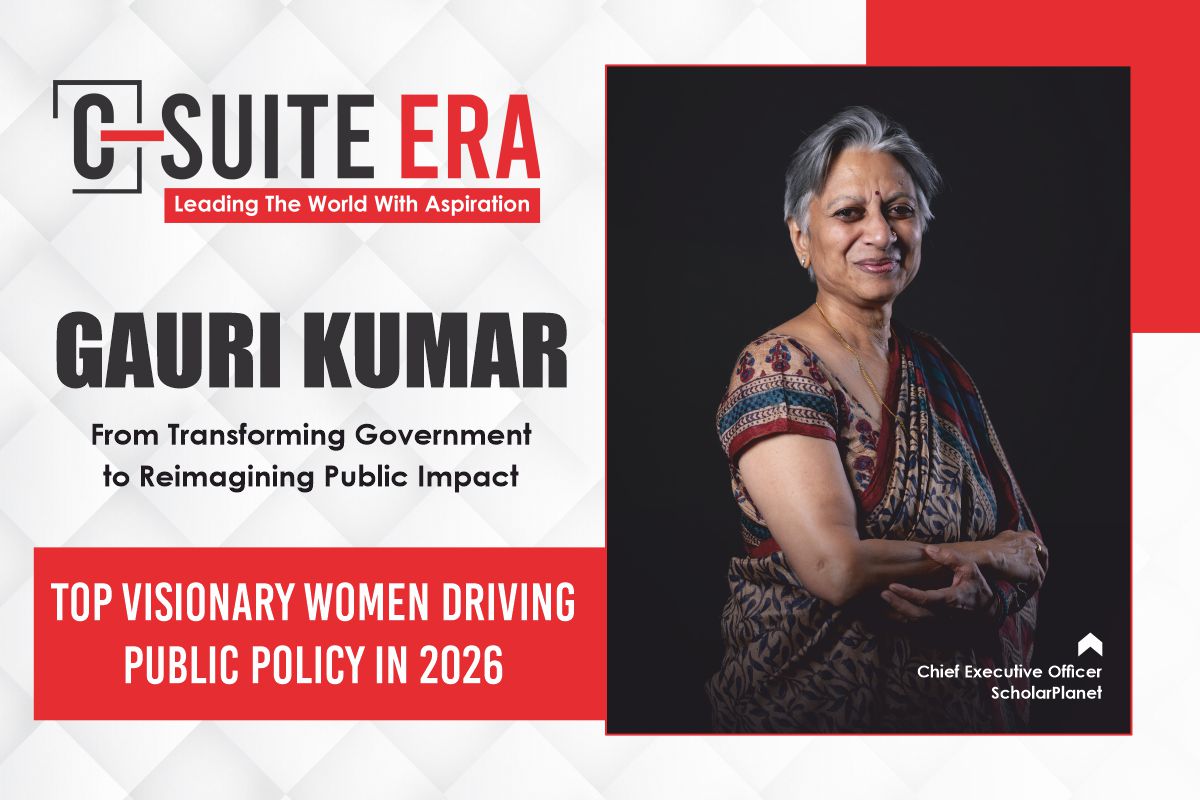
There are public servants who administer systems efficiently, and then there are those who question the systems themselves. Gauri Kumar belongs to the second category.
A retired 1979-batch IAS officer, former Secretary to the Government of India and former Chairperson of the Public Enterprises Selection Board, Kumar has spent much of her career moving between complex assignments in government, industry, labour, education, urban development and public governance. Her professional journey, however, is not simply a catalogue of senior positions. It is better understood as a continuing search for ways to make institutions work differently—and make their impact last.
Today, that search has taken her beyond traditional government administration into collaborative governance, water sustainability and technology-enabled education.
Her story offers an unusual perspective on public policy in India: transformation does not necessarily come from one institution acting alone. It comes when the government, communities, scientists, companies, educators and technology platforms are brought together around a common objective.
The administrator who looked for transformation
Gauri Kumar’s career spans some of the most demanding areas of public administration. According to WHEELS Global Foundation and corporate disclosures, she served in senior positions in both the Government of Gujarat and the Government of India, including Principal Secretary, Industries & Mines in Gujarat; Secretary in the Ministry of Labour & Employment; senior responsibilities in Mines, Environment & Forests and Home Affairs; and Director General of the National Institute of Fashion Technology. She later served as Member and Chairperson of the Public Enterprises Selection Board.
Her academic foundation is equally distinctive. She studied Physics, Mathematics and Statistics at Allahabad University, completed an MSc in Mathematics from Lucknow University, where she received seven gold medals for academic distinction, and later earned a Master in Public Administration from Harvard University’s John F. Kennedy School of Government. Harvard also awarded her a Littauer Fellowship in recognition of academic excellence and public service.
But it is her approach to administration that most clearly defines her.
In her own description, wherever she was posted, she tried first to create a shared vision and then develop an execution plan. Sometimes that meant reforming a process; at other times, it meant changing the way different stakeholders interacted with one another.
Her tenure in Gujarat coincided with the relocation of Tata Motors’ Nano project from Singur to Sanand and the 2009 Vibrant Gujarat Summit, during which Japan participated as a partner country. These episodes became important markers of her experience at the intersection of government, industry and economic development.
At the Union level, another transformation was taking place in the world of social security. During her tenure as Secretary, Ministry of Labour & Employment, Universal Account Numbers were introduced for EPFO subscribers. The idea was deceptively simple but powerful: give workers a more portable and transparent identity for their provident-fund accounts, allowing them to view and manage their accumulated savings more effectively.
For Gauri Kumar , these experiences revealed a larger truth. Government possesses enormous resources, authority and scale, but those strengths do not automatically translate into transformation on the ground.
Discovering the missing link: collaboration
After retirement, Kumar did not step away from public-purpose work. Instead, she moved into a space where government experience could interact with civil society, scientific institutions and philanthropy.
Her work with WHEELS Global Foundation’s Water Council became an important expression of this new approach. The organisation describes its spring-rejuvenation work in Himachal Pradesh as an effort to combine scientific data, evidence-based decision-making, convergence of government schemes, community mobilisation and technology-enabled monitoring.
Gauri Kumar’s central idea was what she calls a “consortium of champions.”
Rather than asking government to solve every problem alone, the model identifies capable actors across different sectors—government officials, NGOs, corporates, scientific institutions and communities—and aligns them behind one measurable objective.
This is particularly relevant in water management, where technical knowledge, government programmes and community behaviour all have to converge.
The Himachal Pradesh spring-rejuvenation project illustrates this philosophy. WHEELS describes a customised portal and dashboard designed to bring data, agencies, departments, scientific inputs and community action together, while IIT Roorkee was involved in outcome monitoring.
The significance of this model goes beyond one water project. Its underlying proposition is that public policy becomes more effective when institutions stop operating in silos.
For Gauri Kumar , technology is not merely a digital convenience. It can become the infrastructure through which otherwise disconnected stakeholders communicate, monitor progress and remain accountable to a shared goal.
The model has subsequently been discussed as an example of collaborative governance and integrated water management.
From water to education: a second act in transformation
Kumar’s next transition was even more unconventional.
During the rapid expansion of India’s EdTech sector, she saw a paradox. India was producing enormous amounts of digital educational content, yet the existence of content did not automatically mean that students—especially those in rural and underserved government schools—were actually using it.
Her response was to build rather than merely critique.
As Founder and CEO of GCAP World and Scholar Planet, Kumar has entered the education-technology space with a platform designed around students, teachers and schools rather than technology alone. Scholar Planet describes itself as an integrated learning ecosystem combining personalised learning, competency-based education, teacher support, real-time insights and institutional analytics.
The company’s stated philosophy is significant: technology should empower the entire education ecosystem rather than displace teachers.
That philosophy closely mirrors Kumar’s experience in public administration.
In Uttar Pradesh, the platform moved from pilot implementation to partnerships involving more than 2,000 government secondary schools, according to the company. GCAP says the programme has the potential to reach approximately five lakh students and reports substantial engagement since its July 2025 launch.
The model is particularly ambitious because it targets precisely the environments where conventional digital-learning assumptions often break down: rural and remote schools, limited infrastructure, uneven digital familiarity and shortages of specialised teachers.
Instead of treating these limitations as reasons not to deploy technology, Kumar’s approach combines the digital platform with human field support.
That hybrid model—technology plus teachers plus field coordinators—is arguably the most revealing feature of her current work.
Putting the teacher back at the centre
For Gauri Kumar , AI is an enabler, not a replacement for human judgment.
Scholar Planet’s ecosystem provides students with curriculum resources, interactive content and personalised learning support, while teachers receive tools for assigning work, monitoring students and understanding where additional intervention may be required. The platform also extends beyond conventional curriculum content into examinations, games, health education and exploratory learning.
This is particularly significant in underserved schools, where the problem is often not simply the absence of a device or internet connection. It is the absence of a complete learning ecosystem.
A digital platform may provide content, but a teacher creates context. A dashboard may identify a struggling student, but a teacher can understand why that student is struggling. A field coordinator can help a school adopt the technology when infrastructure or digital confidence is limited.
This is where Kumar’s decades of administrative experience appear to converge with her entrepreneurial work.
She is not attempting to digitise education for its own sake. She is attempting to build an operating system around the people already responsible for education.
A broader definition of public policy
Gauri Kumar’s current work also reflects an increasingly important evolution in the meaning of public policy.
Public policy is no longer confined to legislation, government orders or departmental programmes. It increasingly involves partnerships, technology, data, behaviour change, community ownership and measurable outcomes.
That is visible across Kumar’s post-retirement work.
In water, the objective has been to connect scientific evidence, government programmes and communities.
In education, it is to connect teachers, students, schools, content, AI and field-level human intervention.
The sectors are different. The underlying methodology is remarkably similar.
Identify the problem. Bring the right champions together. Create a shared objective. Build an execution mechanism. Measure the outcome. Learn from the field. Then scale what works.
That may ultimately be the most compelling thread running through Gauri Kumar’s career.
The work after the designation
Kumar’s post-government portfolio remains substantial. She serves on the boards of organisations including Gujarat Mineral Development Corporation and Gujarat State Fertilizers & Chemicals, among others, and has continued to participate in governance, social-impact and education initiatives.
She has also remained associated with initiatives focused on elderly welfare, water management and school education.
Yet the most striking aspect of her second act is that she has chosen not to simply become an adviser reflecting on a long career.
She has continued to build.
That distinction matters.
Many experienced administrators spend their post-retirement years offering expertise from outside the system. Kumar has instead attempted to create new mechanisms through which that expertise can operate—first through collaborative governance and now through an entrepreneurial education platform.
Where governance meets innovation?
Gauri Kumar’s journey is ultimately less about a particular designation and more about a particular mindset.
From industrial development in Gujarat to labour reform at the national level; from public-sector governance to spring rejuvenation; and from collaborative water management to AI-enabled education, the common thread is her willingness to challenge conventional institutional boundaries.
Her career suggests that the next generation of public-policy leadership will increasingly belong to people who can move comfortably between government and society, policy and technology, evidence and execution.
The question is no longer simply: What can government do?
The more important question is: Who else can government bring together to solve the problem—and how can technology help them work as one?
That is the question Gauri Kumar has spent much of her career answering.
And perhaps that is what makes her particularly relevant to the evolving story of visionary women shaping public policy in 2026: she represents a model of leadership that does not end with retirement from government.
It evolves.
From administrator to reformer. From reformer to collaborator. From collaborator to entrepreneur.
And throughout each transition, the objective remains the same—to turn ideas into systems, systems into outcomes, and outcomes into change that can reach people at scale.
Also Read :- C Suite Era Magazine For More information