


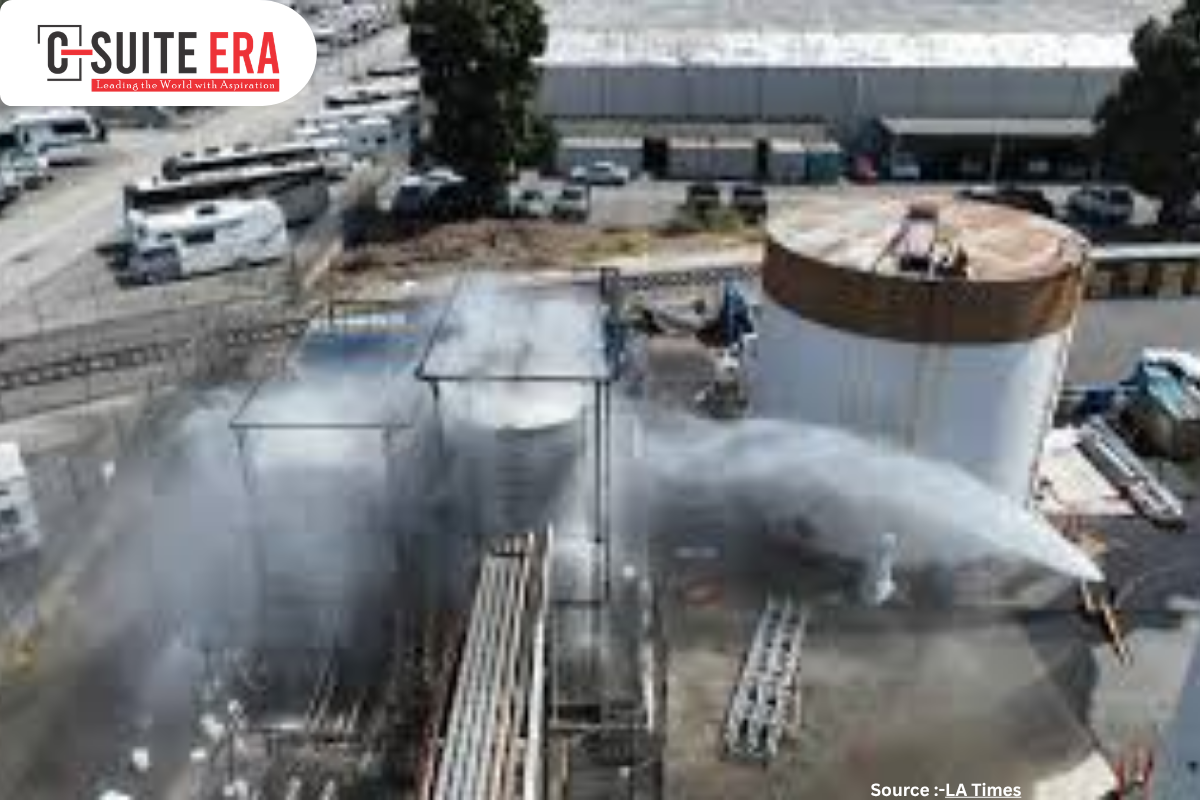
Southern California emergency officials have confirmed that the immediate threat of a catastrophic explosion at a chemical storage tank in Garden Grove has been eliminated, bringing relief after days of heightened concern that forced tens of thousands of residents from their homes.
The incident centered on an overheating industrial tank containing highly flammable methyl methacrylate at the GKN Aerospace facility in Garden Grove, roughly 20 miles south of Los Angeles. Firefighters had warned that the tank, which held nearly 7,000 gallons of hazardous material, faced the possibility of rupture or explosion after temperatures inside the container rose sharply late last week. Emergency declarations and evacuation orders were subsequently issued across a large section of Orange County.
According to the Orange County Fire Authority, overnight operations succeeded in removing the risk of a boiling liquid expanding vapor explosion after crews identified a crack in the tank that relieved internal pressure. The fissure allowed the tank to gradually release pressure, causing temperatures to decline from over 100 degrees Fahrenheit to approximately 93 degrees. Officials described the development as a major breakthrough in containment efforts.
Fire officials stated that while the danger of a blast has now been ruled out, emergency teams remain on-site to monitor the tank and ensure the remaining chemical material can be safely stabilized and removed.
Days of Emergency Response Highlighted Industrial Safety Risks
The California emergency crisis began when the tank at the Garden Grove aerospace manufacturing facility started overheating on Thursday, triggering concerns that the chemical could ignite or rupture violently. Methyl methacrylate is widely used in industrial plastics and aerospace manufacturing but is also highly volatile and can release dangerous fumes under unstable conditions.
As conditions worsened over the weekend, California Governor Gavin Newsom declared a state of emergency and requested federal assistance to support local containment efforts. Evacuation orders impacted tens of thousands of residents across multiple Orange County communities, while schools and businesses in affected areas were temporarily shut down.
Emergency crews deployed extensive cooling measures, including constant water spray systems and drone-based thermal monitoring to track changes in the tank’s structural condition. Authorities also established barriers to prevent any potential runoff from entering storm drains or local waterways if the tank failed.
The California emergency damaged tank’s valve system had reportedly become unusable, complicating efforts to safely drain the chemical through conventional means. This forced responders into a prolonged containment strategy focused on cooling and pressure management rather than direct removal.
Although no injuries or measurable toxic air releases were reported during the incident, health officials warned that any uncontrolled leak could have posed respiratory and neurological risks to nearby populations. Air quality monitoring remained stable throughout the emergency response.
The incident also renewed scrutiny over prior environmental and operational compliance issues linked to the facility, with investigators expected to review maintenance records and tank safety systems once the emergency operation concludes.
California Emergency Chemical Recovery Efforts Continue as Broader Questions Emerge
While the immediate crisis has eased, authorities have cautioned that the site remains an active hazardous materials operation until the chemical contents are fully secured and safely transferred.
Orange County fire officials said evacuation orders may remain in effect for portions of the affected area until engineers complete structural assessments and verify that no additional pressure instability exists. Emergency response teams are now focused on controlled drainage and environmental containment planning.
The event has already triggered broader discussions around industrial risk management in densely populated urban regions. Garden Grove’s proximity to residential neighborhoods and major public destinations underscored how industrial failures can rapidly escalate into large-scale public safety emergencies.
The incident has also raised questions about whether current oversight standards for hazardous chemical storage are sufficient, particularly at facilities located near growing suburban populations. Legal action has already begun, with residents reportedly preparing lawsuits related to evacuation disruption, potential property impacts, and alleged operational negligence.
For California officials, the successful stabilization of the tank marks a significant operational achievement, but the event is likely to prompt deeper regulatory review and renewed examination of emergency preparedness protocols statewide.
As crews continue final containment efforts, the Garden Grove emergency serves as a stark reminder of how quickly industrial infrastructure failures can threaten public safety—and how critical coordinated response systems remain in preventing catastrophe.