

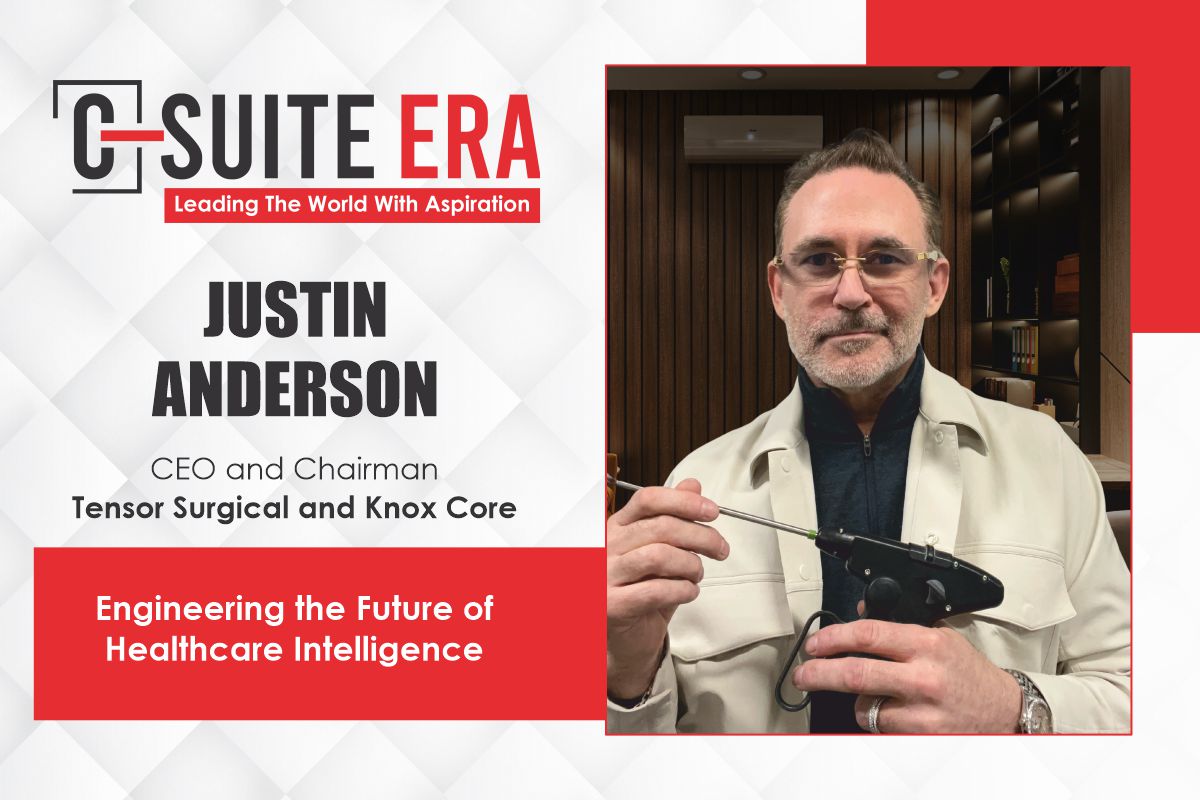
Few executives have successfully navigated operating rooms, manufacturing floors, public markets, and enterprise software architecture. Over more than three decades, Justin Anderson has built a career at the intersection of engineering, medicine, and innovation—helping commercialize technologies that have shaped orthopedic surgery, biologics, digital health, and, more recently, artificial intelligence infrastructure.
Healthcare is entering a period of profound transformation. Artificial intelligence is reshaping how information is created, analyzed, and acted upon. Providers face mounting pressure to improve outcomes while controlling costs. At the same time, advances in robotics, simulation, engineering, and data science are converging in ways that would have been difficult to imagine only a decade ago.
For Justin Anderson , these developments are not isolated trends. They are part of a broader shift toward more integrated approaches to solving complex healthcare challenges.
Throughout his career, Anderson has participated in six successful exits and two public offerings while helping build organizations ranging from early-stage ventures to global commercial operations. His work has consistently focused on identifying opportunities where engineering, clinical practice, and economics intersect to create durable value.
Justin Anderson Today, as Chief Executive Officer and Chairman of both Tensor Surgical and Knox Core, Anderson leads two very different companies united by a common belief: meaningful innovation begins by challenging assumptions that others accept as fixed.
Place this large pull quote INSIDE the image that says TransOs Tunneler…make the quotation marks large…
“The greatest challenge in disruptive innovation is not invention. It is overcoming the institutional inertia that develops when assumptions go unchallenged long enough to become dogma.”
HEALTHCARE AS AN ENGINEERING CHALLENGE
Long before artificial intelligence became a global phenomenon, Anderson was studying complexity inside operating rooms.
Over more than three decades, Anderson worked alongside pioneering orthopedic surgeons whose contributions helped define successive eras of sports medicine and shoulder surgery, including James Andrews, MD, Sumant “Butch” Krishnan, MD, and Brett Sanders, MD. Through those relationships, he gained a rare firsthand perspective on how biological realities, engineering decisions, economics, and surgical execution ultimately converge to determine patient outcomes.
What fascinated him was not simply why technologies succeeded, but why they failed. Solutions that appeared elegant on paper often produced different outcomes in practice. The disconnect reinforced a lesson that would become central to his career: durable innovation requires understanding how multiple variables interact in the real world.
A former professional athlete, two-time World Champion, and five-time National Champion, Anderson also experienced elite sports medicine from the patient perspective. That experience reinforced his belief that the best outcomes emerge when biomechanics, rehabilitation, technology, and execution operate together rather than independently.
Over time, his perspective expanded beyond devices and procedures. Increasingly, he came to view healthcare as a challenge requiring the integration of engineering, biology, manufacturing, and simulation into a cohesive framework capable of improving outcomes at scale.
RETHINKING ORTHOPEDIC SURGERY
At Tensor Surgical, that philosophy is expressed through a challenge to one of orthopedic surgery’s most established assumptions: that better outcomes require increasing implant complexity and hardware utilization.
For decades, innovation in soft-tissue repair has largely focused on stronger fixation constructs and greater implant density. Anderson believes the industry’s next chapter will be driven by a different question—whether outcomes are improving proportionately to the cost and complexity being introduced.
“The goal is not to prove existing approaches wrong. It is to ask whether assumptions that made sense years ago still hold true in light of what we know today. As healthcare evolves toward value-based models, many of those assumptions deserve renewed examination.”
Tensor Surgical’s anchorless approach focuses on preserving bone, reducing implant dependency, and restoring load-sharing biomechanics through minimally invasive techniques. The strategy aligns with broader trends in value-based healthcare, where providers are increasingly evaluated on long-term outcomes, patient experience, and total episode-of-care economics.
For Justin Anderson, the discussion extends beyond any single device or procedure. Future innovation, he believes, will be measured by how effectively biology, mechanics, and healing are integrated into approaches that deliver durable clinical outcomes.
BUILDING THE OPERATING LAYER FOR AI
While Tensor Surgical addresses physical challenges, Anderson and co-founder Xiaoduo Wang launched Knox Core to address digital ones.
“Most people think AI is a model problem,” Anderson says. “We believe it is fundamentally a governance problem. Models will change. Providers will change. The organizations that create lasting value will be the ones that remain in control regardless of who is winning the model race.”
Through Knox Core, Anderson and Wang are developing enterprise infrastructure designed to provide governance, interoperability, memory continuity, and execution control across rapidly evolving AI ecosystems.
At the center of that vision is KnoxOS™, an AI-native operating environment built in Rust and designed to coordinate intelligence across multiple providers and models. Complementing the platform is knox.chat, an execution environment capable of dynamically routing requests while maintaining reliability, continuity, and governance standards.
Justin Anderson believes the next competitive battleground in AI will not be the models themselves, but the governance architecture that determines how intelligence is applied.
“Intelligence is becoming abundant. Judgment is becoming scarce,” he says. “The organizations that win will not necessarily have access to better models. They will have better frameworks for deciding when, where, and how intelligence should be applied.”
A LEGACY OF COMMERCIALIZING INNOVATION
While Anderson’s current work spans orthopedic surgery and artificial intelligence, much of his reputation was built through a career spent bringing complex technologies from concept to widespread adoption.
Across sports medicine, biologics, digital health, and enterprise software, he has repeatedly helped move emerging ideas from theory into clinical and commercial reality. His work has consistently centered on identifying opportunities where engineering innovation can solve larger structural challenges.
Among his most notable contributions was helping pioneer and commercialize modern arthroscopic transosseous repair technologies, including systems that helped reintroduce anchorless soft-tissue fixation into contemporary shoulder surgery.
At a time when much of the orthopedic industry was moving toward increasingly implant-centric solutions, Anderson became an early advocate for approaches emphasizing biology, biomechanics, bone preservation, and long-term healing.
Today, technologies he helped commercialize—and many of the surgical concepts he championed—continue to influence contemporary shoulder surgery. Techniques once considered unconventional are now discussed in major orthopedic literature and leading surgical references. For Anderson, however, innovation has never been about products alone.
That perspective helps explain the common thread running throughout his career. Whether building surgical technologies, commercial organizations, or AI platforms, Anderson has consistently focused on creating foundations capable of generating long-term impact. The technologies may have changed, but the underlying objective has remained remarkably consistent: identifying assumptions worth challenging and building solutions designed to endure.
CHALLENGING ASSUMPTIONS
Despite operating in highly technical industries, Anderson believes meaningful innovation begins with intellectual curiosity and a willingness to challenge accepted thinking.
“The assumptions worth examining are often the ones people no longer realize they are making.”
Within his companies, questioning assumptions is encouraged rather than avoided. Anderson argues that meaningful innovation often emerges when individuals are willing to challenge ideas entire industries have accepted as permanent truths.
Whether evaluating manufacturing systems, software architecture, commercialization plans, or surgical instrumentation, Anderson believes leaders must remain close to the realities of implementation. In his view, organizations evolve in direct proportion to the speed at which reality reaches decision-makers.
The same principles that shaped Anderson’s work in orthopedic surgery increasingly inform his thinking about artificial intelligence and the future of healthcare.
Place this large pull quote INSIDE the image with me presenting on stage at LSI US 2026…make the quotation marks large…
THE NEXT DECADE
Looking ahead, Anderson believes healthcare and artificial intelligence will become increasingly intertwined. Robotics, simulation, manufacturing, clinical data, engineering, and machine intelligence will operate less as separate technologies and more as interconnected capabilities.
The organizations that thrive in that environment, he argues, will be those capable of integrating complexity rather than simply adding to it.
“The future will not be won by organizations with the most data or the most intelligence,” Anderson says. “It will be won by organizations that can transform complexity into actionable judgment at scale.”
It is a vision consistent with the arc of his career.
Across orthopedic surgery, digital health, and artificial intelligence, Anderson has spent more than three decades focused on a single question: what determines outcomes before outcomes become visible?
As healthcare and machine intelligence continue to converge, Anderson remains focused on the same challenge that has defined his career: understanding the forces that shape outcomes long before those outcomes become visible.
Also Read :- C Suit Era Magazine For More information